Turning Brand Milestones Into Cultural Momentum
A framework for how anniversaries and launches become brand-building moments.
Trends & Semiotics
Brand Fundamentals, Workshops & Roadmaps
Comms Architecture & Key Messaging
Milestones should prove what a brand has meant, and where it is going next.
THE PROVOCATION
A 50th anniversary. A 20th birthday. A centennial. Often we see the same playbook: a commemorative logo, a nostalgic ad, a limited-edition product, and a press release. Maybe a great party for the staff.
Some brands are able to take these milestones and generate genuine cultural momentum - shifting perception, recruiting new audiences, and giving existing fans a reason to re-engage - we wanted to unpack why and how.
The brands that win milestone moments treat the anniversary not as the story in and of itself, but as the stage for a bigger one: where the brand is going, not just where it has been.
THE EXPLORATION
We’ve analyzed many leading brands from luxury to mass — from Delta’s 100th to Porsche’s 75th, to IKEA US at 40 to Zara at 50 — across four dimensions: scope and scale of activation, how they balanced heritage and forward momentum, whether the strategy engaged different audiences in different ways (employees, VIPs, customers, corporate), and most importantly how much the milestone actually moved the brand rather than just marking time.
What resulted is a strategic framework that can be applied not just for milestones, but major product launches or other inflection points as well.
THE MILESTONE STRATEGY MAP
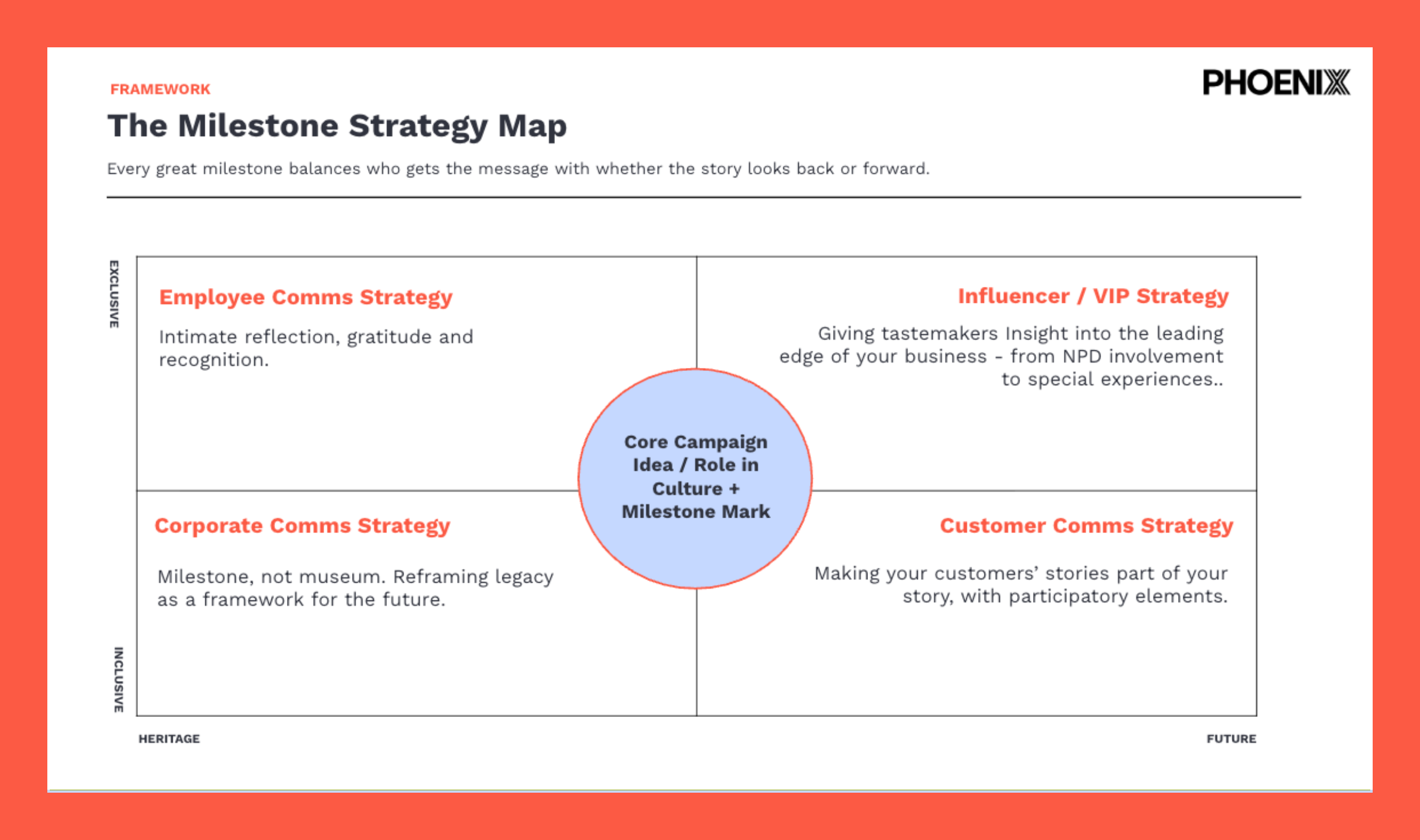
The strongest milestone campaigns operate along two axes that define the map:
Heritage ↔ Future: First, does the campaign look backward (celebrating history, nostalgia, legacy) or forward (unveiling what’s next, signaling evolution)?
Exclusive ↔ Inclusive: Does the campaign speak to insiders (employees, VIPs, loyalty members) or the broader public?
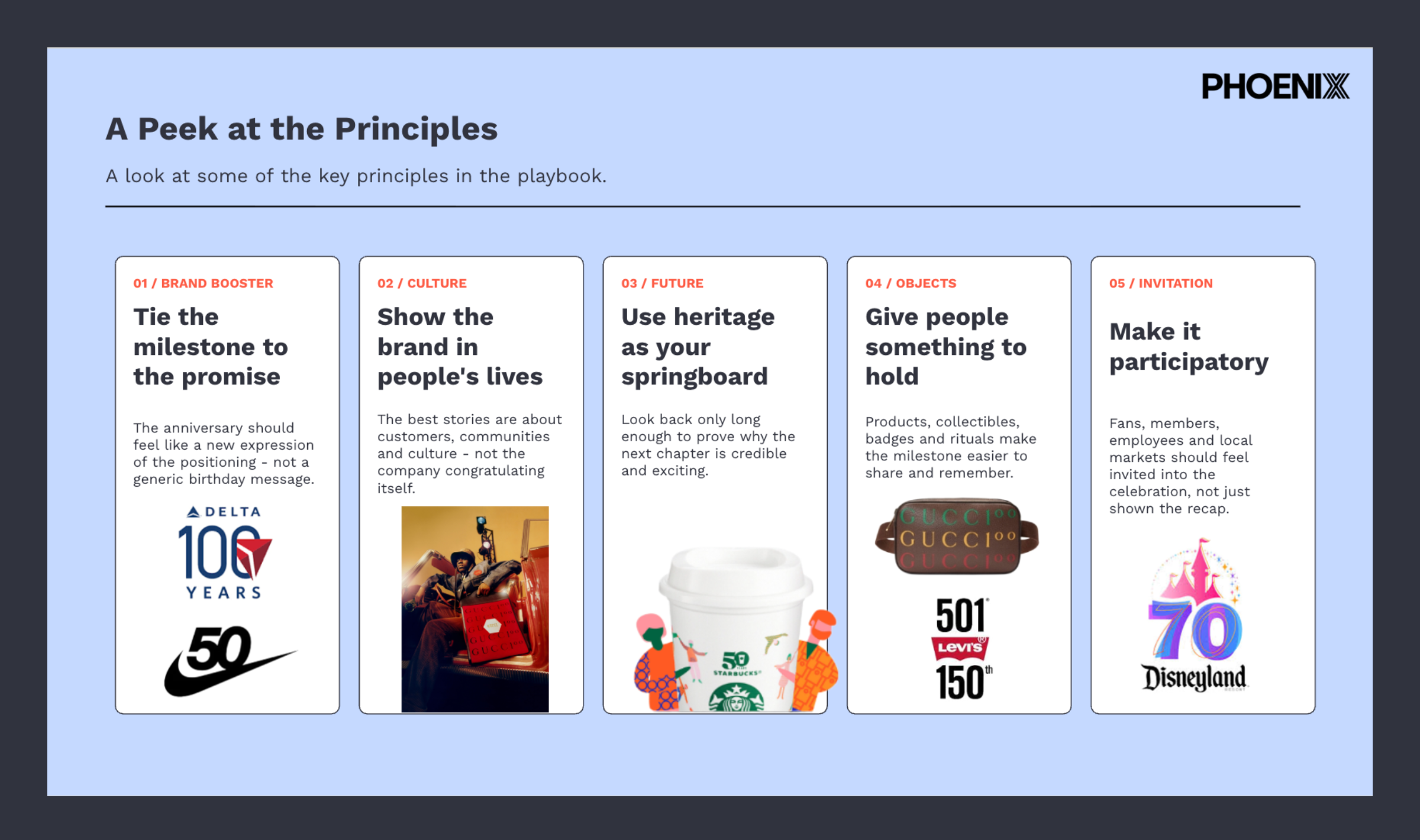
The best campaigns activate across all four, with a synchronized set of activities and elements unified by a single core idea that expresses the brand’s role in culture. Think of Gucci 100, which turned the brand's presence in so many song lyrics (22,703 to be exact) into a limited edition product collection. Or Nike's 50th anniversary We Are Never Done campaign, that highlighted of a half-century of 'Just Do it' mentality. The core idea sits at the center of the map, and everything radiates from it.
The point is not to celebrate the date, but to use the moment to highlight everything you stand for - and how that will continue to pioneer the future.

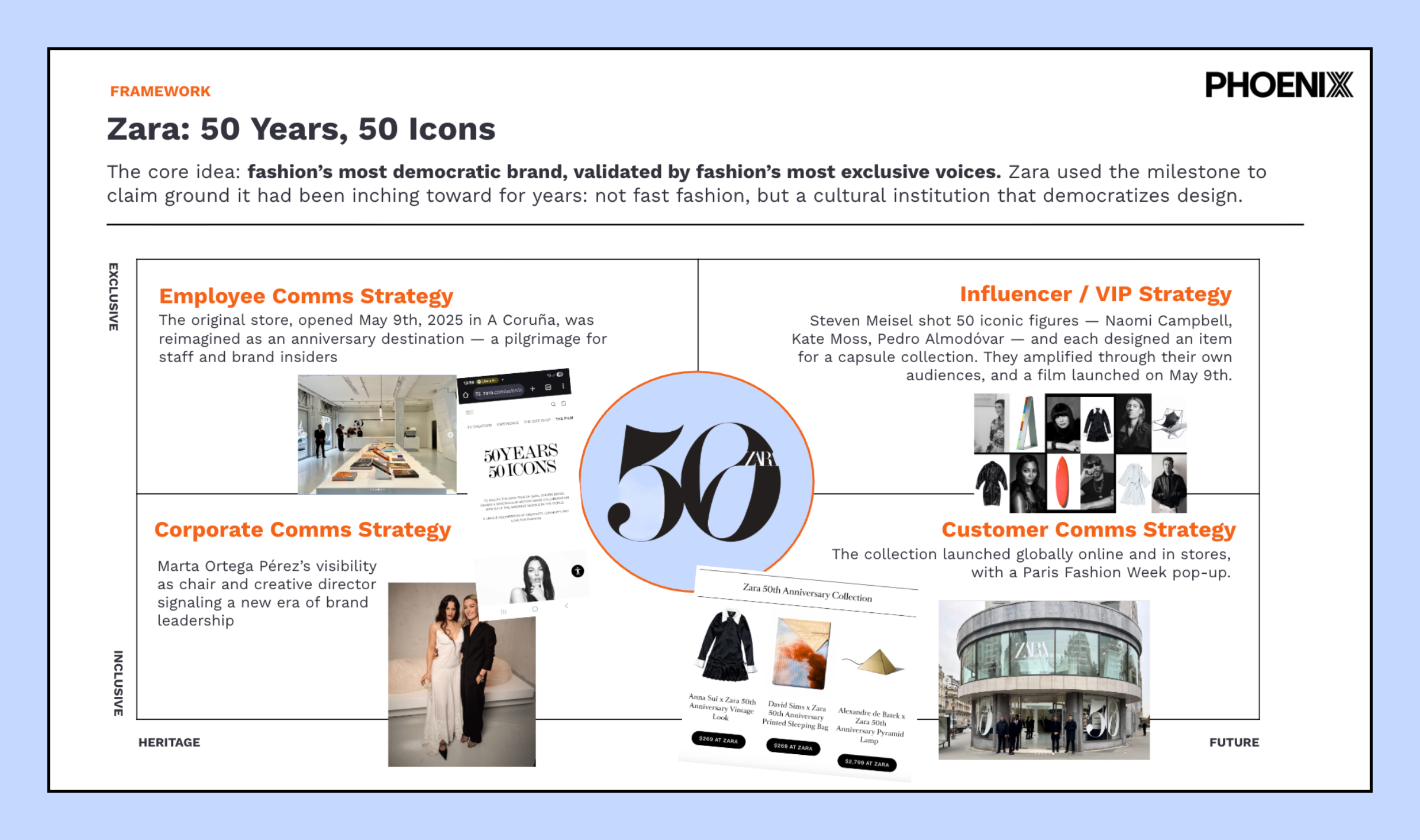
Zara: 50 Years, 50 Icons
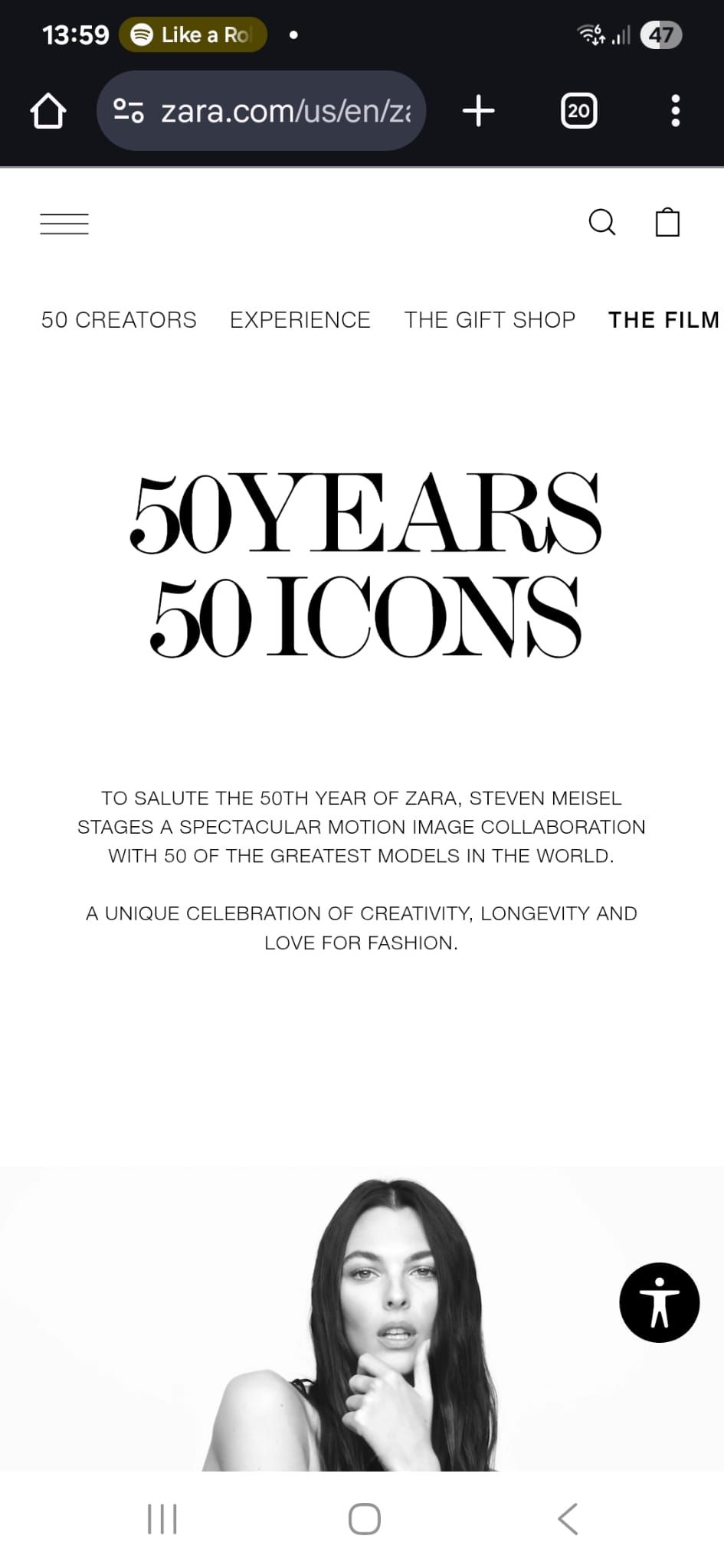
For the 50th anniversary of the brand, Zara commissioned Steven Meisel to photograph 50 cultural icons, from Annie Leibovitz to Pedro Almodóvar to Rosalía, who had each designed a limited-edition object for the occasion.
The result was a capsule collection, a documentary, and an insider launch event series.
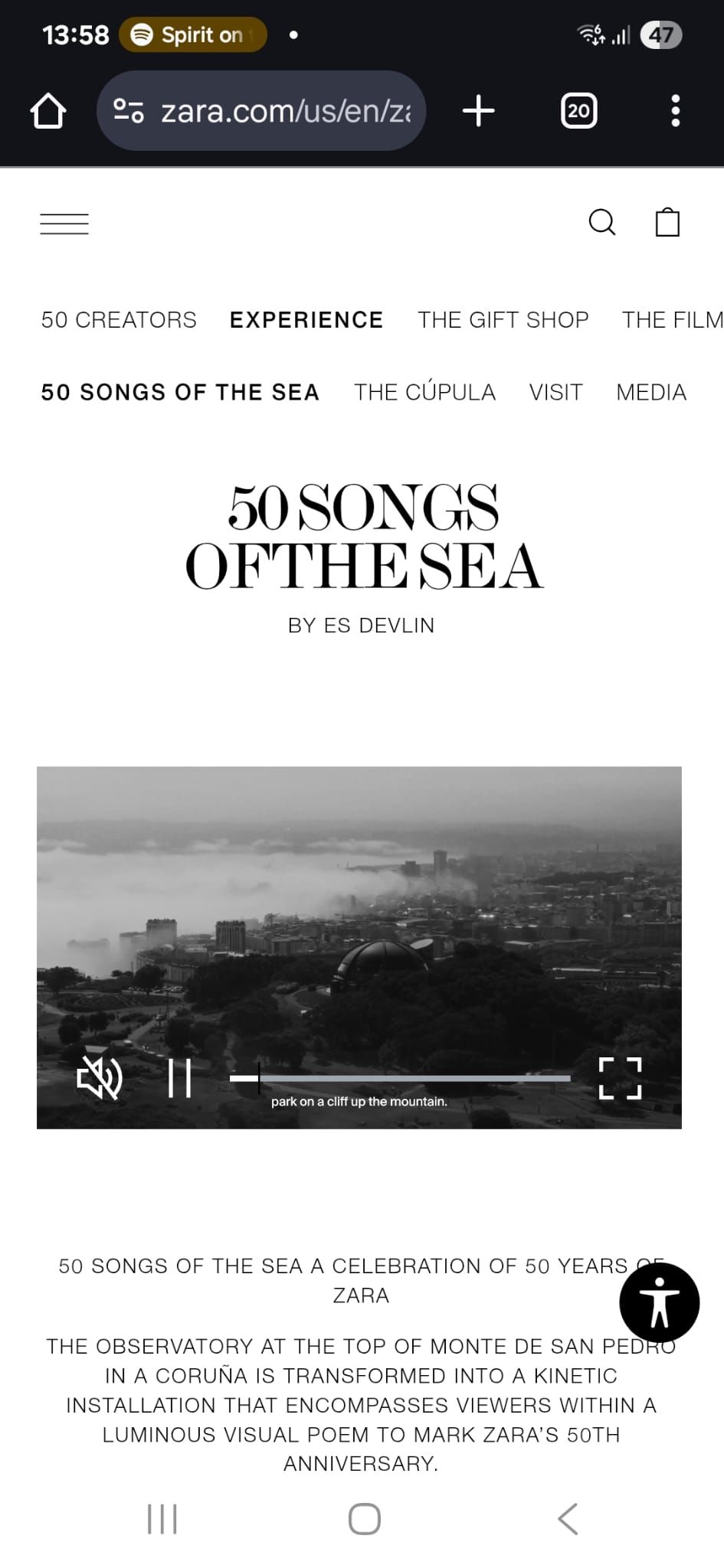
- Employee / heritage: The first Zara store in A Coruña became a mini pilgrimage site with an immersive exhibit for employees and superfans.
- VIP / future: 50 tastemakers helped shape and distribute the collection, supported by exclusive parties, pop-ups, and a unifying 50th anniversary logo.
- Customer/ future: The limited collection was dropped to the public along with an in-store and in-app experience - making the rest of the world part of the celebration.
- Corporate / heritage: Finally, the new collection quietly underscored the changing of an era under the new creative leadership of Marta Ortega Pérez.
Zara's 50th was almost like a brand repositioning in disguise - shifting them from fast fashion to a timeless brand that democratizes good design.

Spotify's 20th: Your Party of the Year(s)
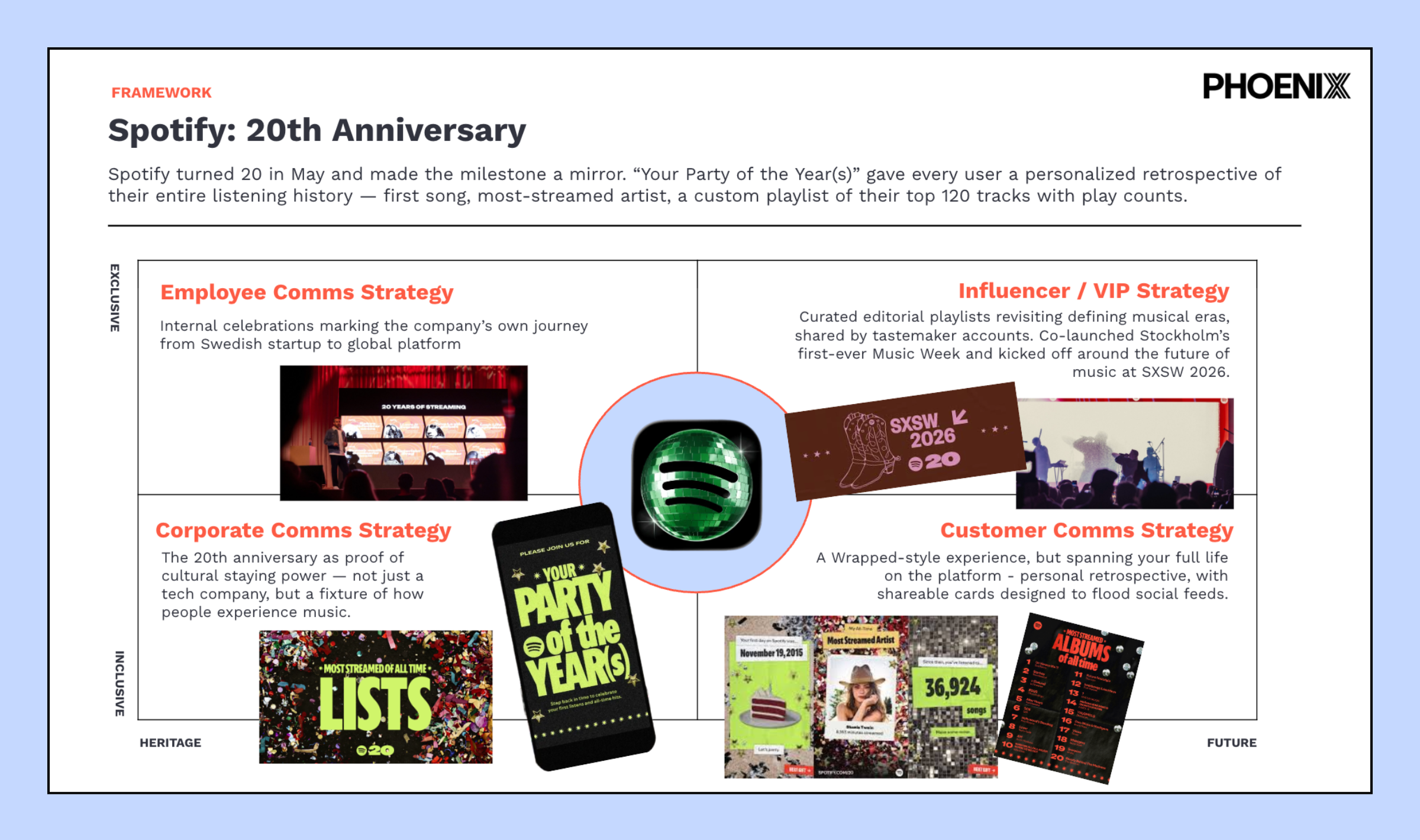
In May 2026, Spotify marked its 20th by turning the app into an individual retrospective for every fan — complete with a controversial sparkly green disco-ball app icon swap. The campaign was anchored by the "Your Party of the Year(s)" campaign, but activations stretched across the map.
- Employee / heritage: Launching the first-ever annual Stockholm Music Week close to home along (with internal celebrations) underscored the brand's role of pioneering the future of music.
- VIP / future: SXSW gave artists, creators, and industry insiders a future-facing launch moment, and a range of curated playlists dropped.
- Customer / future: Building on the Wrapped tradition, "It's Your Party" dropped in everyone's feed, complete with cards made for sharing your stats and highlights across social.
- Corporate / heritage: The anniversary reinforced Spotify’s role in changing how people discover, share, and experience music.
Spotify didn't just throw a party for themselves, they celebrated 20 years of listeners seeing themselves through music.
WHAT PHOENIX CAN HELP WITH
This framework applies to more than anniversaries. It works for heritage product relaunches, brand pivots and refreshes, partnership milestones, and major launches and inflection points.
What you’ve seen is the map. The full system is the audit, scoring, prioritization, and workshop process.
Planning something?
We can help you turn the date into a strategy.
The Phoenix team has been both valuable and a pleasure to partner with. Their research has provided thorough insights into user problems and needs, helping shape our product strategy and prioritization
- Rosie
PM, Noom, Inc.